





8 October 2026
The plinking cowboys
For anyone fascinated by cowboys, the Wild West and the legendary six-shooters of the American frontier, few guns capture the spirit of the era quite like the Colt single-action revolver – BY ROBIN BARKES
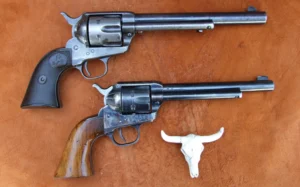
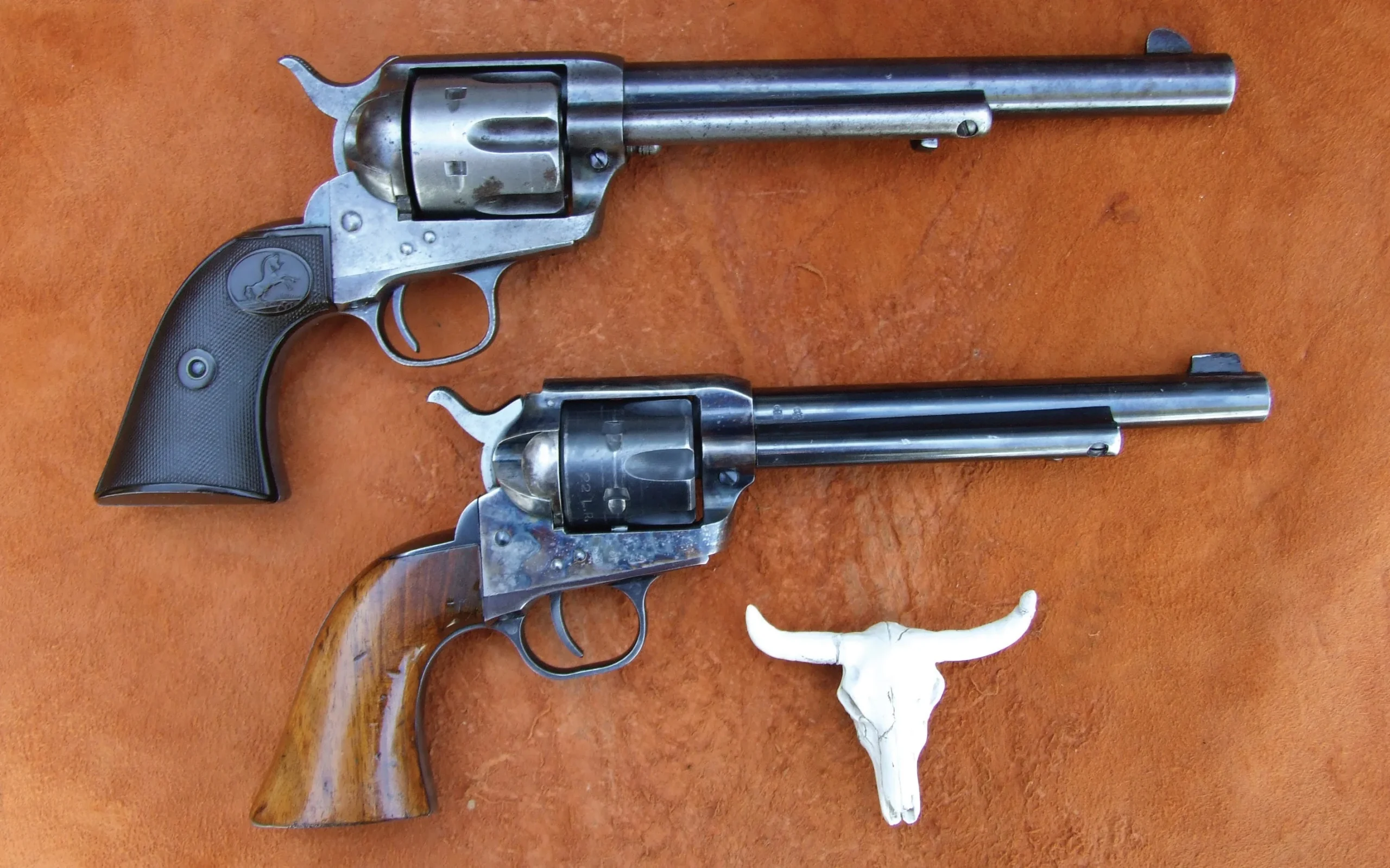
The Uberti .22 (bottom) compared to a full size Colt .44-40.
My interest in the Wild West means that any gun used during that period gets my full attention – in particular Colt six-shooters.
For a while now, I have spent a few hours every Sunday morning shooting a variety of Colts. The six-shooters range from cap-and-ball guns to cartridge takers; some are antiques, others are modern replicas.
Caplock replicas are generally accurate copies both inside and out but the mechanics of centre-fire replicas differ somewhat from the originals. As long as the gun looks like a Colt, feels like a Colt, and rides a holster like a Colt, that’s okay with me – provided it’s well made.
Many years ago I owned a cheap continental copy of a Colt that took .32 long cartridges. After a few years of hard use, the barrel worked loose and wobbled on the frame. I got rid of the gun. Later, I bought another, better quality Colt clone but within a few years the recoil shield surrounding the firing pin wore down causing the primers to back out and jam the cylinder. I got rid of the gun.
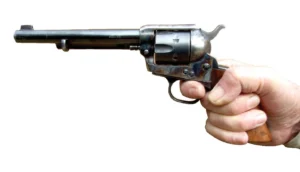
Although scaled down, the light .22 provides a comfortable grip.
These days practising with a Colt or its clones can be an expensive exercise. Shop-bought .45 or .44-40 ammo costs a heap of dough. Heck, in the late 1800s a cowpoke paid less than a dollar for a packet of ammo. It is not generally known that when Colt introduced their famous single-action revolver in 1873, they offered a .22 version.
The very low production figures of the .22 indicate that the boys out West were not interested in pipsqueak calibres. What they wanted was a large calibre revolver that could stop a hostile Indian in his tracks, or blast a rustler off his horse, or flatten an opponent in a gunfight.
In 1957 Colt brought out a .22 called the Frontier Scout which was a ⅞ scale model of the larger revolver. The .22 had plastic grips, a polished aluminium frame and a rolled steel tube with a seam to hold the ejector rod – I guess Colt was trying to keep pace with all the imitations flooding the market.
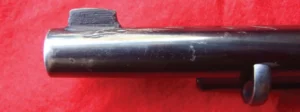
Possibly reworked, the Uberti front sight differs from the old Colt shape.
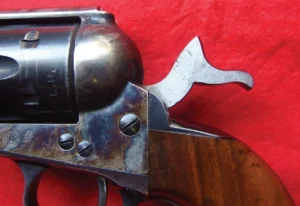
The smooth hammer face on the .22 strikes a rebounding firing pin.
In 1961 Colt produced another .22 six-shooter; the nickel-plated Frontier Scout and a year later the last Frontier Scout, called the K model was offered with a blued, heavier frame. Colt introduced their .22 Peacemaker in 1970 with a second cylinder taking .22 Magnum cartridges. This too was short lived and production ceased in 1974.
I must admit that all the above information was gleaned from my very early copy of History of Colt. So if Colt produced another .22-calibre revolver based on their original single-action six-shooter after 1976, then I haven’t come across it.
Luckily out of the gloom and into the sun rode Mr Uberti and Company to produce an almost spittin’ image of a Colt six-shooter in .22 calibre.
THE SIX-SHOOTER
When a friend showed me his Uberti .22 six-shooter I agreed that at first glance it was all Colt – except the gun is slightly scaled down so its slimmer 6¼-inch barrel does not look out of place on the frame and it’s lighter than a full-size Colt six-shooter.
Also obvious is the fact that it did not have the familiar Colt sharks fin shaped front sight and the smooth striking face of the hammer lacks the claw-like firing pin found on original Colt revolvers.
This is the six-shooter we practise with every weekend to hone our shooting skills. The great thing about shooting a .22 is that it saves a heck of a lot of money. Just compare the price of a packet of .22 cartridges to ammo of a larger calibre and you’ll catch my drift.
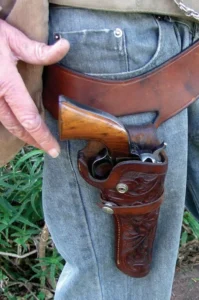
The Uberti rides a western-style holster as well as any six-shooter.
The walnut-stocked butt on the Uberti provides a good grip and the gun points naturally. It’s a real pleasure to shoot and, like the 1970 .22 Colt Peacemaker, the Uberti replica came with a second cylinder taking .22 Magnum cartridges. This option provides a good calibre for hunting small game. To keep running costs down we practise with .22 Long Rifle cartridges.
When shooting a revolver with fixed sights for the first time, I always determine the correct hold by firing three shots from a rest using the six o’clock hold on the bull. That way I can see where the gun puts the bullets and I can correct my hold.
When I first fired the Uberti it did not take long to find out that I would have to hold low and slightly to the right to put a bullet into the black. Things went well for a few outings and I found the Uberti to be the perfect plinker turning many a tin can into a cheese grater. Then one day the Uberti seemed to change its mind and began delivering its lead onto a different place on the target. This meant I had to start all over again to work out a different hold.
DIFFERENT AMMO
But then, a couple of weeks later, the gun would again change its mind and shoot a different way. “What in tarnation is going on?” I asked the gun owner. “Quite understandable,” he replied, “we are using a different make of ammunition.”
That’s when a light bulb flickered in the dark depths of my brain. I remembered reading an article in Gun Digest in which a gun writer had the same trouble.
So one day he sat down at a bench with his .22 rifle and laid out every brand of ammo he could lay his hands on. He then commenced shooting groups from the various boxes of ammo — each with its own target set up at the same range. The results were quite astonishing.
Although some cartridges did shoot to the same point of aim, the rest grouped all over the target. In my younger days, a .22 cartridge was a .22 cartridge no matter who made it. These days things are different and there is a wide range of .22 ammo available. I decided to carry out my own experiment at our next shoot.
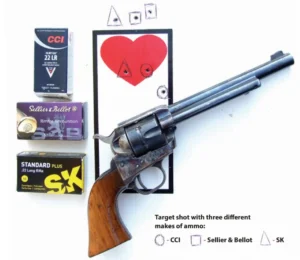
On the range I took two cartridges each from a box of CCI, Sellier & Bellot and SK ammo and loaded the Uberti. Then, stepping up to a mark fifteen paces from the target, I took a steady two-handed grip on the gun. Using a six o’clock hold on the heart-shaped bull I touched off the first two shots and marked the hits. I then fired the next two shots with different ammo and marked the hits differently.
The same procedure was followed with the last two shots using the third brand of ammo and a different mark. After a reload my companion had a go at a clean target with the three brands of ammo and the results were marked in the same way.
I have shown here the target shot by my compadre because his eyes are a lot better than mine. As you will see the two shots with Sellier & Bellot ammo produced the best group and had a finer front sight been taken, they would have drilled the heart.
If anything, my little experiment made me realise that I was still living in the past and these days the many different brands of .22 cartridges deliver their bullets to different places on a target.
With the serious experimenting over, we settled down to our usual fun shooting. Our favourite action is to simulate a gunfight by slowly walking towards a target while we shoot from the hip. In this ‘walking fire’ exercise my friend used a genuine Colt .357 while I kept to the Uberti.
When the guns were empty we swopped and I found the muzzle blast of the heavy Colt very different to the soft-shooting Uberti .22. Then, taking turns with the .22, we began pig plinking and balloon busting before we made empty cartridge boxes jump all over the backstop.
We ended the session using an antique Winchester pump-action .22 rifle to shoot at tin cans and scattered blocks of wood. What glorious fun. Hail the mighty .22 that gives you more shooting for less money.
(This article was published in the January/February 2021 edition of ManMAGNUM)
ALSO READ