







6 October 2026
The quagga: What is fact and what is fiction?
Much controversy, speculation and intrigue follow the now extinct quagga (Equus quagga quagga). Was it a distinct species, or merely a subspecies of the plains zebra? – BY ROSS KETTLES
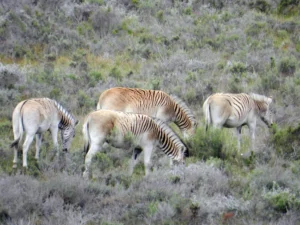
In bright sunlight, the coats of Rau Quaggas always appear lighter than they actually are. In reality, from a distance with the naked eye, it is easy to mistake them for Cape eland, so similar is the fawn colouration.
What did the Equus quagga quagga actually look like, and was their behaviour any different to the plains zebra (E. quagga, formerly E. quagga burchelli)?
Sadly, most early history of the quagga is lost. The first reliable records of the species only started appearing in the latter half of the 18th century; prior to this, explorers and travellers simply referred to them as wild horses or mules.
Following European settlement in South Africa, a combination of extensive hunting and habitat loss, as the quagga competed with domesticated animals for forage, led to their rapid decline and eventual extinction.
A few breeding programmes in zoos in Europe were initiated, but were ultimately unsuccessful. The last fragmented wild population is documented as having lived in the Orange Free State in the mid-1800s, but because all zebra sub-species were referred to as quagga, uncertainty exists as to their actual physical attributes.
The last captive specimen died in a zoo in Amsterdam in 1883. Only 23 skins are known to exist today.
Early researchers recognised different subspecies of plains zebras as members of Equus quagga, though much confusion existed as to which species were valid. Initially, quagga subspecies were described on the basis of differences in striping patterns, but these differences have since been attributed to individual variation within the same populations (known as polymorphism).
Further confusion resulted from subspecies being based only on illustrations of aberrant quagga specimens. Studying skeletons from stuffed specimens can also lead to confusion, as early taxidermists sometimes used donkey and horse skulls inside their mounts when the originals were unavailable. In addition, it is likely that only skin specimens displaying aberrant patterns were preserved.
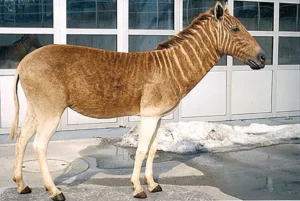
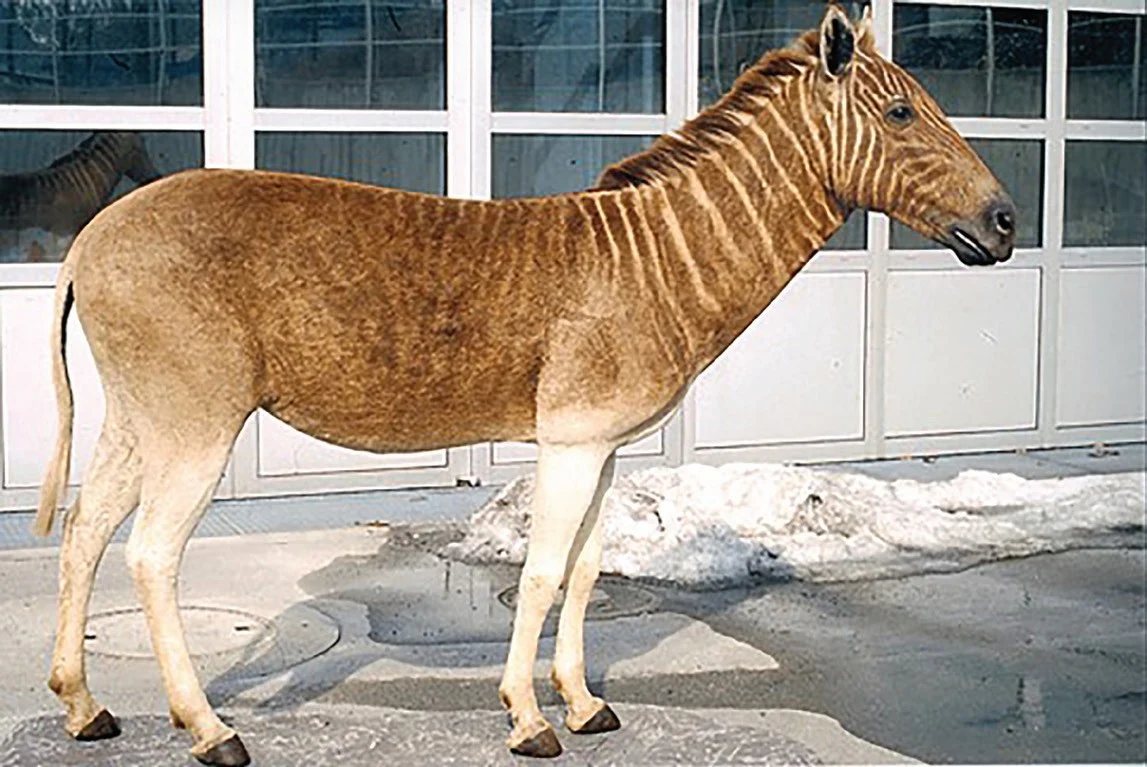
Munich Museum exhibit.
QUAGGA SKINS AND SKULLS
A 2004 study of skins and skulls instead suggested that the quagga was not a distinct species, but a subspecies of the plains zebra. In spite of these findings, many authors subsequently kept the plains zebra and the quagga as separate species.
A genetic study published in 2005 confirmed the subspecies status of the quagga. It showed that the quagga had little genetic diversity, and that it diverged from the other plains zebra subspecies only between 120 000 and 290 000 years ago, during the Pleistocene.
Its distinct coat pattern perhaps evolved rapidly because of geographical isolation and/or adaptation to a drier environment. In addition, plains zebra subspecies tend to have less striping the further south they live, and the quagga was the most southern-living of them all. Other large African ungulates also diverged into separate species and subspecies during this period, probably because of the same climate shift.
The quagga’s coat pattern was unique among equids: zebra-like in the front but more like a horse in the rear. It had brown and white stripes on the head and neck, brown upper parts and a white belly, tail and legs. The stripes were boldest on the head and neck and became gradually fainter further down the body, blending with the reddish brown of the back and flanks, until disappearing along the back.
It appears to have had a high degree of polymorphism, with some having almost no stripes and others having patterns similar to the extinct southern population of Burchell’s zebra, where the stripes covered most of the body except for the hind parts, legs and belly. It also had a broad dark dorsal stripe on its back and a standing mane with brown and white stripes.
THE PHOTOGRAPH
The only quagga to have been photographed alive was a mare at the Zoological Society of London’s Zoo. Only five photographs of this specimen are known to exist, taken between 1863 and 1870. On the basis of photographs and written descriptions, many observers suggest that the stripes on the quagga were light on a dark background, unlike other zebras.
Living in the very southern end of the plains zebra’s range, the quagga had a thick winter coat that moulted each year. Like other plains zebras, the quagga did not have a dewlap on its neck as the mountain zebra does.
The 2004 morphological study found that the skeletal features of the plains zebra population and the quagga overlapped, and that they were impossible to distinguish. Some specimens also appeared to be intermediate between the two in striping, and the extant plains zebras with Burchell’s zebra genes still exhibit limited striping. It can therefore be concluded that the two subspecies graded morphologically into each other.
Today, some stuffed specimens of quaggas and southern Burchell’s zebra are so similar that they are impossible to definitely identify as either, since no location data was recorded.
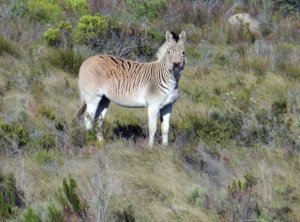
Rau Quagga at the Nuwejaars Wetlands Special Management Area.
CLOSE RELATIONSHIP
After the very close relationship between the quagga and extant plains zebra was first discovered in 1984, as the first extinct animal to ever have its DNA examined, naturalist Reinhold Rau’s research in quagga kick-started the Quagga Project in 1987 in South Africa. The objective was to create a quagga-like zebra population by selectively breeding for a reduced stripe pattern from plains zebra stock, a process known as “breeding back”. The eventual goal is to re-introduce them to the quagga’s former range.
To differentiate between the quagga and the zebras of the project, they refer to them as “Rau Quaggas”. The founding population consisted of 19 individuals from Namibia and South Africa, chosen because they had reduced striping on the rear body and legs. The first foal of the project was born in 1988.
On the Agulhas Plain, close to Bredasdorp, the 46 000-hectare Nuwejaars Wetlands Special Management Area hosts one of the biggest Rau Quagga populations in the country.
Initiated by Mick D’Alton on the farm Kosierskraal in 1991, with subsequent relocations over the years, the area now hosts 3 viable herds. Interestingly, observations on Nuwejaars suggest that environmental factors such as weather and vegetation may also play a role in polymorphism, as subsequent foals, from the same mare and stallion, often exhibit stronger quagga characteristics than its preceding sibling.
Will initiatives like this ‘bring’ the quagga back? We will never know for sure, but it will bring back individuals, and eventually herds which will closely resemble the extinct quagga. One has to acknowledge though, that the E. quagga genes have been here all along.
(This article was published in the November/December 2021 edition of ManMAGNUM)
ALSO READ