


20 July 2026
Be Prepared!
by KOOS BARNARD
Get ready, the leaves are falling…
Hunting season is upon us, the mornings are crisp and the evenings are getting cooler. If you haven’t started your annual hunting preparation yet, do so without further delay. In the 2023 March/April edition of Magnum I wrote an article that covered numerous things hunters need to take into account when preparing for the hunting season. Here are some more tips that you might find useful.
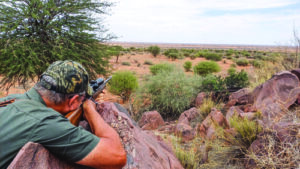
Check your rifle, spend time on the shooting range and get your gear ready for the hunting season.
Let’s start with your rifle. If you haven’t used it regularly during the off-season, now is the time for a thorough check-up. Any cracks in the stocks or maybe a rusty spot here and there on the steel? Are the guard screws still tight? A while back I had a surprise with my BRNO .22 Hornet. During a plinking session at gongs at 100m it suddenly produced flyers. A quick check revealed that one action screw needed tightening by almost a full turn, after which the rifle returned to its normal accuracy.
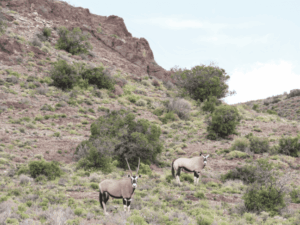
In open country, long shots are often called for. Being familiar with your calibre/bullet combination’s trajectory out to say 350m, or further, is very helpful.
If your rifle has a free-floating barrel and a wooden stock, check to see if the barrel is indeed still free-floating. The Western Cape experienced a very wet winter during 2024 and the humidity in the coastal town where I live is high. I had to remove wood from the barrel channels of both my .243 and .375 rifles – the wood had absorbed moisture and was touching the barrels. Check out the sling swivel studs too – are they still tight? A sling that comes loose may cause you to drop and damage your rifle.
Once you are happy with the rifle’s metalwork and stock, check out the scope-mounts and rings. When in my twenties, I once wounded a springbuck and traced the problem to scope ring screws that had worked loose.
If you are a novice shooter or new to the hunting game, think twice before buying a big, high-magnification scope for general hunting. It seems to me that many hunters (too many I think), want to be snipers these days. Heavy target-type scopes with 30 or 34mm tubes, exposed turrets (without turret caps) and parallax adjustment seem to be the order of the day. The exposed turrets and the parallax adjustment drum can be a real nuisance on walk-and-stalk hunts. When a right-handed shooter carries his rifle over his shoulder in the conventional way, these knobs constantly rub against your body and may cause accidental adjustment of the scope’s settings and parallax. A turret lock will prevent accidental adjustment but many scope brands do not have that feature.
Target scopes are wonderful for competition shooting, voorsit shooting or sniping at varmints from specialized shooting chairs or rests, but not great for general hunting when, at times, you need to shoot quickly and at distances closer than 150m. Big scopes add weight and bulk, making the rifle clumsy and unwieldy. Some hunters use their rifle scopes as binoculars and when doing so, often crank the magnification up to maximum but then forget to turn it down again. When they need to shoot quickly at closer ranges the magnification is too high, making it difficult to find the animal in the field of view.
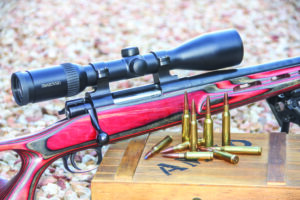
Keep things simple when hunting – standard hunting scopes with low-profile,
capped turrets often work better, especially for walk-and-stalk hunters.
Scopes with all kinds of bells and whistles are fine for certain applications but I firmly believe that one should keep things simple for hunting. Also remember that you don’t need 25x magnification for antelope hunting, even out to 400m. I have done a fair amount of shooting out to 400m recently and my tests once again confirmed that 12x magnification is more than enough for taking on springbuck-sized antelope at that distance.
Many hunters prefer to dial their scopes when engaging targets that are further away than their zeroing distance. I prefer scopes with additional hash marks for aiming off at longer distances. To take full advantage of hash marks, you need to do some calibrating on the shooting range. I find hash marks more convenient than cranking away at the turrets whenever I spot an animal. Find out through practical tests which system works for you and get thoroughly acquainted with your choice of method. If you prefer to dial for distance and your scope doesn’t have one of those “ballistic” turrets with colour-coded markings, mark the different zeroing distances on the turret with drops of paint or a waterproof marker; it beats having to count clicks when you are in a hurry to shoot.
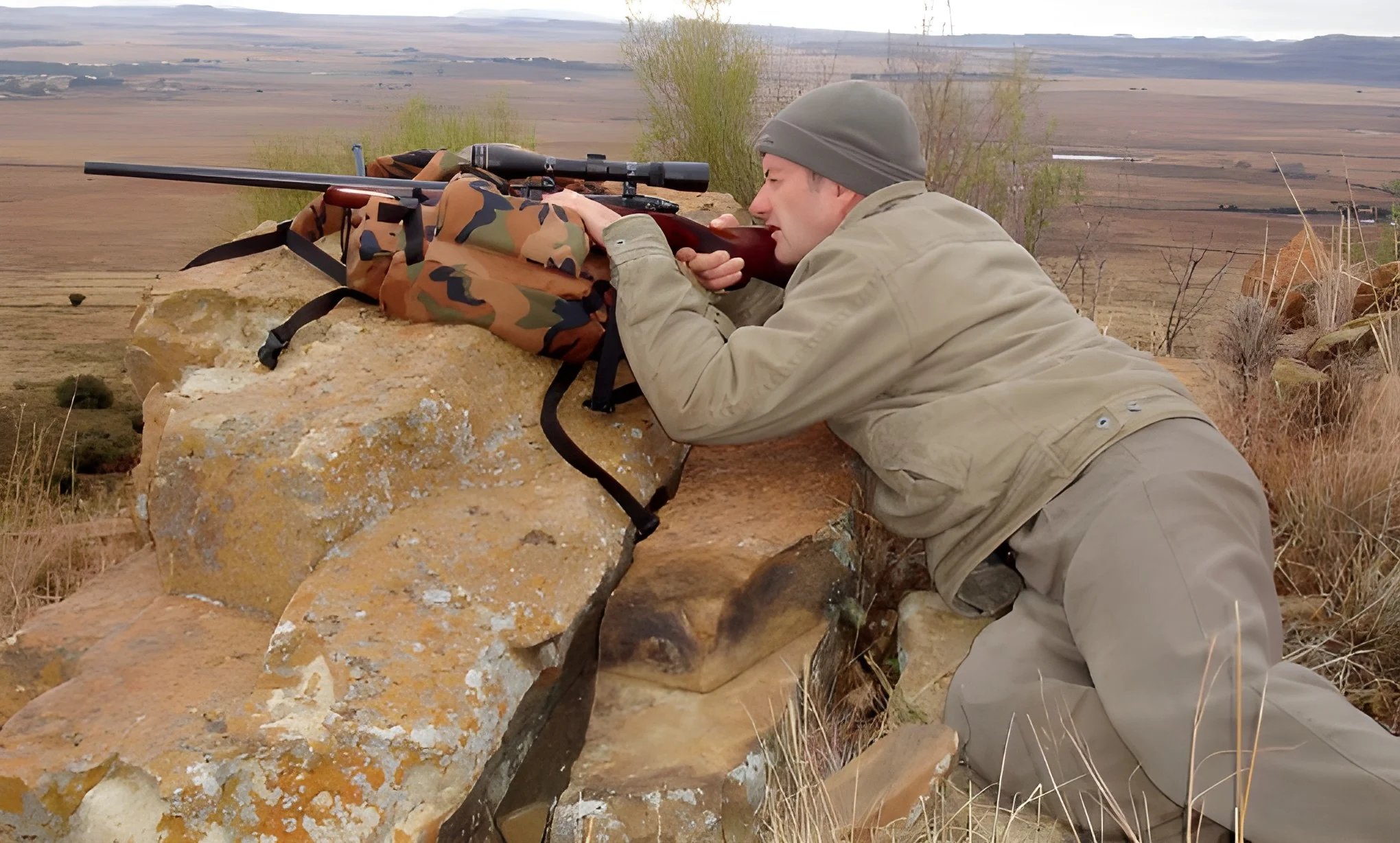
Too many hunters fall into the trap of investing in “better” equipment when they fail to bring target and bullet together. Rather invest time on the shooting range, firing from various field positions instead of using a bench. In November 2024 I organized a gong shoot near Montagu. Shooters had to engage three targets at 300m from the sitting position while using a single-point support and two targets at 400m from the prone position. Most shooters had great difficulty hitting the 300m targets from the sitting position but did much better from the prone position at 400m. Shooters also had to engage a 20cm target at 200m without the use of an artificial rest (arms/rifle resting over knees only was allowed) and only two of 38 shooters were successful.
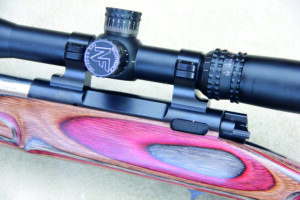
Big, high-magnification scopes with exposed target-type turrets and parallax
adjustment are not the best option for the walk-and-stalk hunter.
Shooting sticks are popular field rests and are often used from the standing position to clear high vegetation. Ones like the 4DeadHold or similar which allow the shooter to support the fore-end and the butt stock on a rest work extremely well. These sticks are fairly expensive, but worth every cent. Outfitters/PHs usually supply shooting sticks, some in the form of a home-made tripod offering a single-point support for the rifle’s fore-end only. Learn to shoot off these as well. It is also good policy to practise off-hand shooting, especially if you plan on hunting in the bushveld. At times, shots need to be taken quickly and at distances under 75m.
I find full-colour, life-size targets featuring game animals extremely useful during my pre-season shooting preparations. As you probably know, the vitals on these targets are drawn in with faint lines that are invisible from a distance. Using them not only teaches you where the vitals are, but also gives feedback about trajectories and what the maximum distances are at which you can still hit the vitals reliably.
In 2024, I guided hunters for the first time after many years and was surprised to find that some were not familiar with their calibres’ trajectories beyond 200m. I was asked several times: “Where do I aim, where do I aim?” If you are a hunter, it is essential to familiarize yourself with your equipment and bullet trajectories. Do not rely on ballistic apps for that information, they are only as accurate as the information you feed them and even then, the predictions are not always 100% correct. Nothing beats practical shooting sessions on a range to determine trajectories.
Make a habit of keeping all your essential hunting equipment in a special hunting trunk. This ensures that you don’t have to run around looking for, say, binoculars, ammo pouches, knives or whatever before a hunt. Some put all their hunting, shooting and camping stuff in the same trunk; I keep my camping equipment in a separate one – my hunting trunk contains only knives, knife sharpener, GPS, binoculars, rangefinder, ammo pouch, camera and a few other bits and pieces.
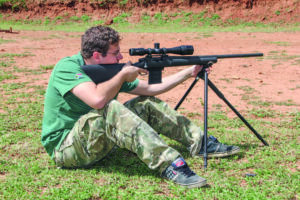
Use adjustable shooting sticks that you can employ quickly, and learn to shoot from a variety of field positions.
If you plan to hunt in Namibia this year, apply for an export/import permit for your rifles and ammunition in good time because the permit can take up to three months to be issued. To apply, you will need a letter of invitation to hunt from the Namibian landowner or concession holder. The DFO will inform you of any additional documents you’ll need to submit with the application. To bring meat and/or trophies back, import/export permits are required for that as well. Apply directly to the Dept Agriculture, Land Reform & Rural Development in Pretoria. The application forms are available from the Directorate Food Imports & Exports Standards.
Remember that all our provinces require a hunting licence and/or permits (special permits are required to transport warthog and bushpig meat). Some provinces do not require a hunting licence if you hunt on exempted farms (properties with a certificate of adequate enclosure), while others do. All provinces require a letter of permission to hunt from the landowner or his representative. This letter also gives you permission to remove the meat. Have it available at all times when travelling. Hunting licences are available from the provincial offices of the state veterinarian, magistrate’s offices, post offices, hunting associations and from some firearms dealers.
Always ensure that you are hunting legally and within the hunting season. Also check whether restrictions limit the gender and numbers of animals that may be hunted.
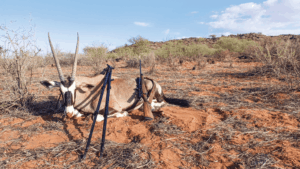
High vegetation often requires the hunter to take shots from the standing position. Shooting
sticks that allow rests for the rifle’s fore-end and butt stock provide a stable shooting platform.
A word or two on hunting apparel. Avoid boots that have hard soles; these are too noisy on gravel or in rocky terrain. Soles that have aggressive tread also make more noise. My favourite boots are flat-soled from Wildebees. They are not great for climbing or use in wet conditions but I wear them all the time and manage quite well. Running shoes are not really suitable for rough terrain but their soft soles are perfect for silent stalking in flat bushveld country.
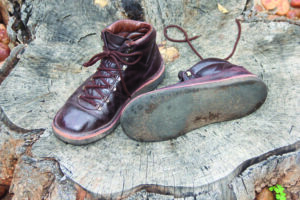
Walk-and-stalk hunters need boots that will allow them to move
silently. My favourites are these Wildebees boots with soft, flat soles.
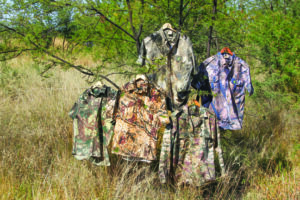
Some camo patterns and colours do not blend in well with the surrounds.
Always match your camos with the terrain you will be hunting in.
If you wear camos, avoid those with light-coloured patches in the pattern. In the Klein Karoo where I do most of my hunting now, I have seen time and again how light-coloured camos stand out. Darker colours usually blend in much better with the surrounds – unless you are crossing a plain covered in pale winter grass.
Start early, prepare well and enjoy a successful hunting season.